The 2-Axis Slant Bed CNC Lathe is a specialized machine tool designed for high-precision and efficient machining of cylindrical parts. This article aims to provide an in-depth understanding of the design principles, operational mechanisms, and the unique advantages that make the 2-Axis Slant Bed CNC Lathe a preferred choice in modern manufacturing environments.
Design Principles Behind the 2-Axis Slant Bed CNC Lathe
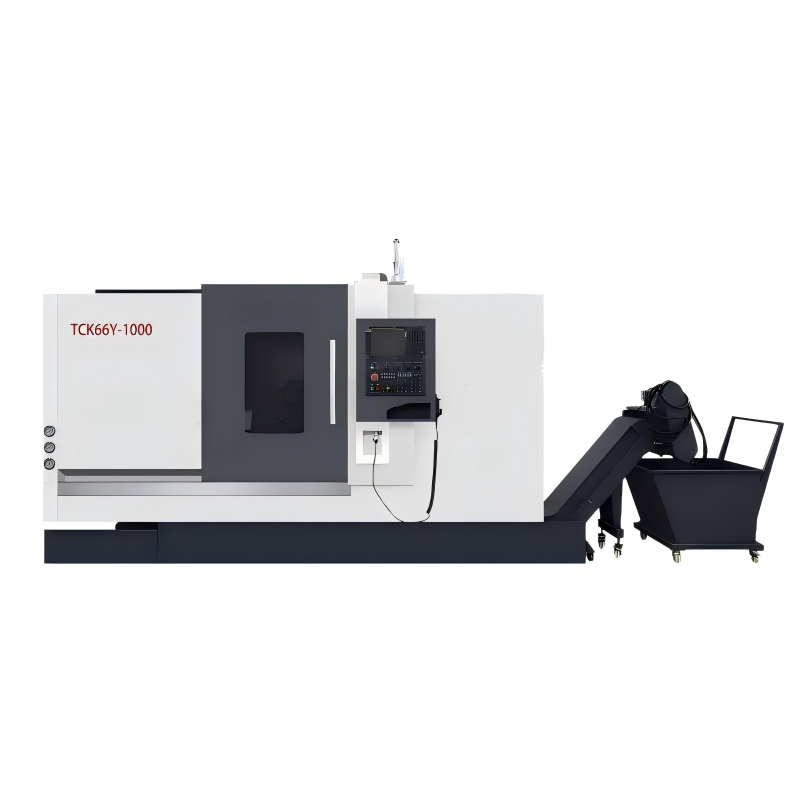
The 2-Axis Slant Bed CNC Lathe's design is fundamentally different from traditional lathes, starting with its slanted bed. The slanting of the bed, typically at an angle between 30 to 45 degrees, serves several critical purposes. Firstly, it allows for better chip evacuation, as chips naturally fall away from the cutting area, reducing the risk of re-cutting and improving surface finish. Secondly, the slanted bed provides increased rigidity, which is crucial for maintaining accuracy during heavy cuts or when working with harder materials. This rigidity also contributes to longer tool life and reduced wear on the machine itself.
Beyond the bed, the 2-Axis Slant Bed CNC Lathe incorporates advanced control systems that enable precise control over both the X-axis (cross slide) and Z-axis (main spindle). These axes work in concert to achieve complex geometries and tight tolerances, making this type of lathe ideal for applications requiring high precision and repeatability. The integration of computer numerical control (CNC) technology further enhances the machine's capabilities by allowing for automated operations, programming flexibility, and the ability to store and recall multiple job setups, thus streamlining production processes.
Operational Mechanisms and Performance Characteristics
The operational efficiency of the 2-Axis Slant Bed CNC Lathe is significantly influenced by its design. The slanted bed not only improves chip management but also facilitates better access to the workpiece, allowing for more versatile tooling options. Operators can easily approach the part from various angles, enhancing the range of possible machining operations. Additionally, the slanted bed reduces the overall footprint of the machine, making it suitable for facilities with limited space.
Another key aspect of the 2-Axis Slant Bed CNC Lathe is its ability to handle a wide range of materials, including metals, plastics, and composites. The robust construction and high-torque spindles ensure that the machine can effectively cut through tough materials while maintaining dimensional accuracy. The CNC system allows for the fine-tuning of parameters such as feed rates, spindle speeds, and tool paths, enabling operators to optimize performance for specific materials and part geometries.
Furthermore, the 2-Axis Slant Bed CNC Lathe often includes features such as automatic tool changers, coolant systems, and integrated probing, which enhance its versatility and productivity. Automatic tool changers reduce setup times and allow for continuous operation, while coolant systems help in maintaining consistent temperatures and extending tool life. Integrated probing systems enable in-process measurements and adjustments, ensuring that parts meet the required specifications throughout the machining process.
Advantages and Applications of the 2-Axis Slant Bed CNC Lathe
The 2-Axis Slant Bed CNC Lathe offers several advantages that make it a valuable asset in many manufacturing settings. One of the primary benefits is its high precision and repeatability. The combination of a rigid slanted bed and advanced CNC controls ensures that parts are machined to exact specifications, with minimal variation from one piece to the next. This consistency is particularly important in industries where tight tolerances are critical, such as aerospace, automotive, and medical device manufacturing.
Another significant advantage is the machine's versatility. The 2-Axis Slant Bed CNC Lathe can perform a wide range of operations, including turning, facing, threading, and drilling, all within a single setup. This capability reduces the need for multiple machines and decreases the overall production time. Additionally, the ability to program and store multiple job setups makes it easy to switch between different parts and production runs, enhancing the machine's adaptability to changing demands.
In terms of applications, the 2-Axis Slant Bed CNC Lathe is widely used in the production of components for various industries. In the automotive sector, it is used to manufacture engine parts, transmission components, and brake systems. In the aerospace industry, it is employed for the production of turbine blades, landing gear components, and structural parts. In the medical field, it is used to create surgical instruments, implants, and other precision components. The 2-Axis Slant Bed CNC Lathe's ability to handle a variety of materials and its high precision make it a versatile solution for a broad range of manufacturing needs.
In conclusion, the 2-Axis Slant Bed CNC Lathe is a powerful and flexible machine tool that combines advanced design principles with state-of-the-art CNC technology. Its unique features, such as the slanted bed, high rigidity, and precise control systems, make it an excellent choice for high-precision and efficient machining. Whether in the automotive, aerospace, or medical industries, the 2-Axis Slant Bed CNC Lathe continues to play a vital role in modern manufacturing, driving innovation and excellence in part production.
 23/06/2026



