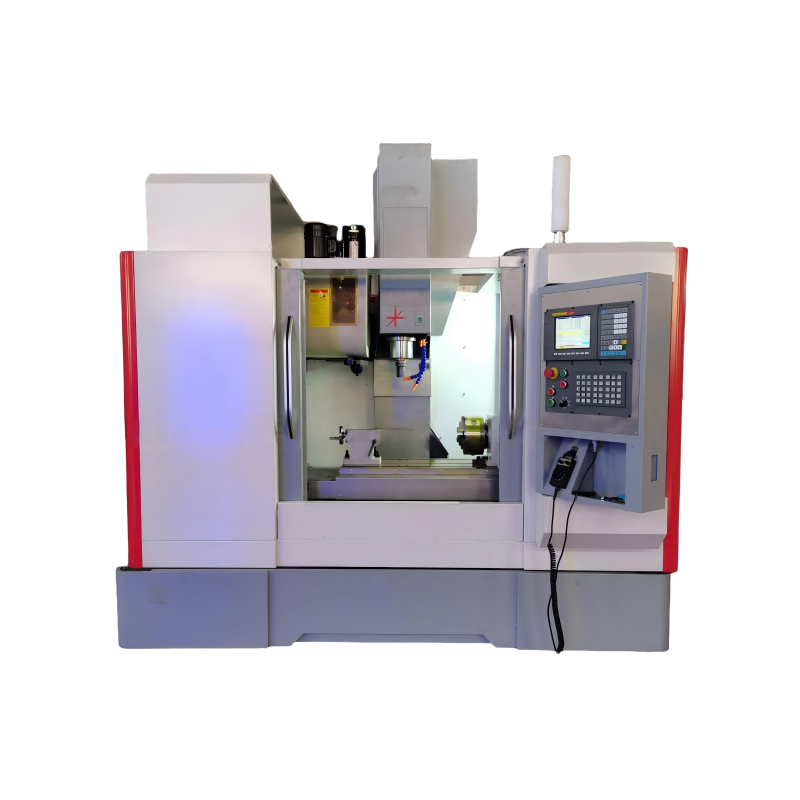
The small vertical Machining Center (VMC) has become an indispensable tool in modern manufacturing, especially for producing complex parts with high precision. This article delves into the capabilities of a small VMC, highlighting its versatility and efficiency in handling intricate components.
Enhanced Precision Through Advanced Control Systems
A small VMC is equipped with advanced control systems that significantly enhance its precision. These systems include high-resolution encoders, servo motors, and sophisticated software algorithms. The combination of these technologies allows for precise positioning and smooth motion, which are crucial for achieving tight tolerances in complex parts. For instance, in the aerospace industry, where components must meet stringent standards, a small VMC can produce parts with sub-micron accuracy. This level of precision is essential for ensuring the reliability and performance of critical components.
Moreover, the advanced control systems enable real-time monitoring and adjustment, reducing the risk of errors and improving overall part quality. Features such as adaptive control and predictive maintenance further enhance the machine's performance, making it a reliable choice for high-precision manufacturing.
Flexibility in Material and Tooling Options
One of the key advantages of a small VMC is its flexibility in handling a wide range of materials and tooling options. Whether it's aluminum, stainless steel, or exotic alloys, a small VMC can process various materials with ease. This versatility is particularly valuable in industries like automotive and medical, where different materials are used to achieve specific properties in the final product.
In addition to material flexibility, a small VMC also supports a variety of tooling options. From standard end mills and drills to specialized cutters, the machine can accommodate a wide array of tools. This flexibility allows manufacturers to optimize their processes and achieve the desired results efficiently. For example, in the production of intricate medical implants, a small VMC can use micro-cutting tools to create fine features and smooth surfaces, ensuring the highest quality and functionality.
Efficient Multi-Axis Machining for Complex Geometries
Small VMCs often come with multi-axis capabilities, enabling them to handle complex geometries with ease. While traditional 3-axis machines are limited to X, Y, and Z axes, a small VMC can be equipped with additional rotary axes, such as A, B, and C, allowing for 4-axis or even 5-axis machining. This capability is particularly useful for producing parts with intricate shapes and features, such as those found in the aerospace and mold-making industries.
Multi-axis machining not only enhances the complexity of the parts that can be produced but also improves the efficiency of the manufacturing process. By reducing the need for multiple setups and repositioning, a small VMC can complete a part in a single operation, saving time and minimizing the risk of errors. For example, in the production of turbine blades, a 5-axis small VMC can machine the entire blade in one setup, ensuring consistent quality and reducing lead times.
Integration with Automation and Digital Manufacturing
The integration of a small VMC with automation and digital manufacturing technologies is another significant advantage. Automated systems, such as robotic arms and automatic tool changers, can be seamlessly integrated with a small VMC to create a highly efficient and productive manufacturing cell. This integration allows for continuous operation, reducing downtime and increasing throughput.
Furthermore, the adoption of digital manufacturing technologies, such as computer-aided design (CAD) and computer-aided manufacturing (CAM), enables the creation of detailed part programs and simulations. These tools help in optimizing the machining process, predicting potential issues, and ensuring that the final product meets the required specifications. For instance, in the electronics industry, where miniaturization and high precision are critical, a small VMC can be programmed to produce complex circuit boards with high accuracy and repeatability.
Cost-Effectiveness and Return on Investment
Despite its advanced capabilities, a small VMC is a cost-effective solution for many manufacturing operations. The compact size and energy-efficient design of a small VMC make it suitable for small to medium-sized enterprises, where floor space and budget constraints are common. Additionally, the high productivity and low maintenance costs of a small VMC contribute to a quick return on investment.
By leveraging the capabilities of a small VMC, manufacturers can reduce production costs, improve quality, and increase their competitiveness in the market. For example, in the automotive industry, a small VMC can be used to produce high-precision engine components, resulting in better fuel efficiency and performance. The cost savings and improved product quality can translate into higher customer satisfaction and increased market share.
In conclusion, a small Vertical Machining Center offers a range of capabilities that make it an ideal choice for producing complex parts. Its enhanced precision, flexibility in material and tooling options, efficient multi-axis machining, integration with automation and digital manufacturing, and cost-effectiveness all contribute to its value in modern manufacturing. As technology continues to advance, the small VMC will remain a vital tool for manufacturers seeking to produce high-quality, complex components.
 28/06/2026



