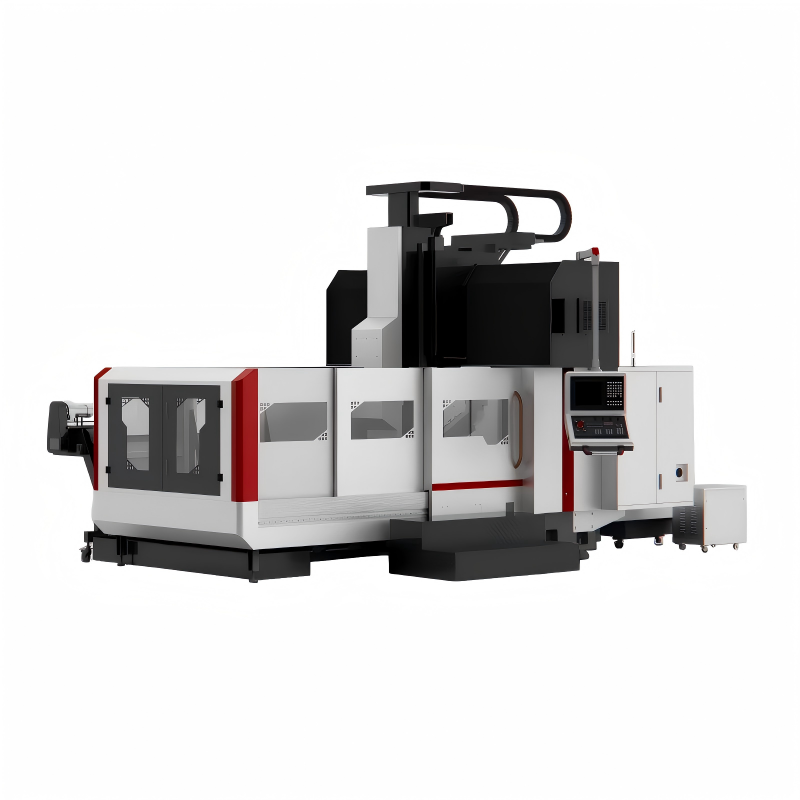
In the realm of precision manufacturing, CNC (Computer Numerical Control) milling machines play a crucial role. A key component that significantly influences the efficiency and accuracy of these machines is the gantry design. This report delves into how the design of the gantry impacts various aspects of CNC milling operations, providing insights for engineers and manufacturers seeking to optimize their processes.
The choice of materials for the gantry is fundamental to its performance. High-strength alloys and composites are preferred due to their ability to withstand the high forces and vibrations generated during milling. Materials like aluminum and steel are commonly used, with aluminum offering a good balance between strength and weight, while steel provides superior rigidity and durability.
Optimizing the gantry's design through finite element analysis (FEA) ensures that it can handle the dynamic loads without compromising structural integrity. Techniques such as ribbing and hollow sections can be employed to reduce weight while maintaining strength. Additionally, the use of modular designs allows for easier maintenance and upgrades, enhancing the overall lifecycle of the CNC milling machine.
The linear guide systems within the gantry are critical for ensuring precise movement. High-precision ball screws and linear guides minimize backlash and provide smooth, accurate motion. These components must be carefully selected and installed to ensure minimal wear and tear, which can lead to inaccuracies over time. Regular maintenance and calibration are essential to maintain the required level of precision.
Temperature variations can cause thermal expansion and contraction, leading to dimensional changes in the gantry. Effective thermal management systems, such as cooling channels and temperature sensors, help to mitigate these effects. By maintaining a stable operating temperature, the CNC milling machine can achieve consistent and accurate results, even during extended periods of operation.
The drive system, including motors and drives, plays a vital role in the speed and efficiency of the CNC milling machine. High-torque servo motors and advanced control algorithms enable rapid and precise movements. The gantry design must accommodate these components, ensuring they are optimally positioned for maximum performance. Additionally, the use of high-efficiency power supplies and energy recovery systems can further enhance the overall efficiency of the machine.
Excessive vibrations can reduce the speed and accuracy of the milling process. The gantry design should incorporate effective vibration damping mechanisms, such as dampers and isolators, to minimize the transmission of vibrations from the cutting tool to the structure. This not only improves the surface finish of the milled parts but also extends the life of the machine by reducing wear on critical components.
A modular gantry design allows for greater flexibility and adaptability in CNC milling operations. Modules can be easily reconfigured or replaced to accommodate different workpiece sizes and shapes, as well as varying machining requirements. This modularity also facilitates upgrades and maintenance, as individual components can be swapped out without the need for a complete overhaul of the machine.
Modern CNC milling machines benefit from advanced software integration, which enables seamless communication between the gantry and other components. Software tools for simulation, optimization, and real-time monitoring can significantly enhance the machine's performance. By integrating these tools, operators can fine-tune the gantry's parameters, ensuring optimal efficiency and accuracy for each specific task.
While a well-designed gantry may require a higher initial investment, the long-term savings in terms of reduced maintenance costs and increased productivity often justify the expense. High-quality materials and components, along with robust design, can lead to a longer operational lifespan and fewer breakdowns. This, in turn, reduces downtime and maintenance costs, providing a better return on investment over the machine's lifetime.
Regular maintenance is crucial for keeping the CNC milling machine in optimal condition. The gantry design should facilitate easy access to critical components, making routine inspections and repairs more efficient. Implementing a preventive maintenance schedule, including lubrication, cleaning, and periodic checks, can help to identify and address potential issues before they become major problems. This proactive approach not only extends the life of the machine but also ensures consistent performance and reliability.
The design of the CNC Milling Machine Gantry is a critical factor in determining the efficiency, accuracy, and overall performance of the machine. By focusing on structural integrity, precision, speed, flexibility, and cost-effectiveness, engineers and manufacturers can create gantries that meet the demanding requirements of modern manufacturing. Through careful material selection, design optimization, and the integration of advanced technologies, the gantry can be tailored to deliver the highest levels of performance and reliability.
 04/06/2026
Introduction to Gantry-Based CNC MillingIn the rapidly evolving landscape of modern manufacturing, CNC milling machine gantry systems have emerged as a pivotal technology, capable of meeting the increasingly complex demands of various industries. These sy
Read More03/06/2026Introduction to Advanced CNC Milling Machines In the realm of modern manufacturing, the role of Computer Numerical Control (CNC) milling machines has become increasingly significant. These advanced systems, including those with a robust CNC Milling Machin
Read More02/06/2026IntroductionThe advent of CNC (Computer Numerical Control) milling machines has revolutionized the manufacturing industry, enabling high precision and efficiency in the production process. Among the various components that contribute to the performance of
Read More01/06/2026Introduction to CNC Milling Machine InnovationsThe field of Computer Numerical Control (CNC) milling machines has seen a significant evolution over the past few decades. This technology, which is fundamental to modern manufacturing, continues to push boun
Read More30/05/2026Introduction to CNC Milling MachinesCNC milling machines are a cornerstone of modern manufacturing, providing precision and efficiency in the production of parts. A key component of these systems, particularly for larger workpieces, is the gantry. The CNC
Read More29/05/2026Introduction to Gantry Systems in CNC Milling In the world of precision machining, the CNC milling machine gantry plays a pivotal role in determining the accuracy, stability, and overall performance of the machining process. This article delves into the e
Read More28/05/2026IntroductionThe integration of CNC (Computer Numerical Control) milling machines into modern manufacturing processes has revolutionized the way complex projects are approached. These sophisticated devices, particularly those equipped with gantry systems,
Read MoreOur professional sales team is always ready to assist you.