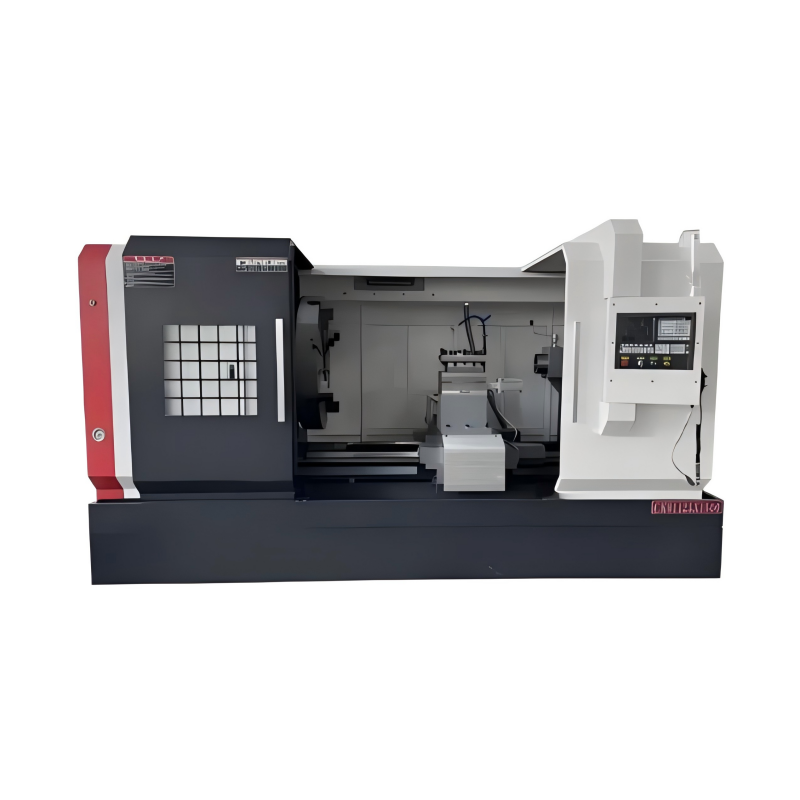
The Economic 2-Axis CNC Lathe represents a significant advancement in the field of manufacturing, offering an affordable yet efficient solution for many machining needs. This type of lathe is particularly popular among small to medium-sized enterprises due to its cost-effectiveness and versatility. However, like any piece of machinery, it comes with both advantages and limitations that are crucial for potential users to understand before making an investment.
Cost-Effectiveness: A Major Selling Point
The primary advantage of the Economic 2-Axis CNC Lathe lies in its affordability. For businesses looking to enhance their production capabilities without breaking the bank, this machine offers an ideal solution. Its relatively low upfront cost compared to more advanced multi-axis lathes makes it accessible even for startups or companies operating on tight budgets. Additionally, the operational costs associated with a 2-Axis CNC Lathe tend to be lower as well, thanks to its simpler design which requires less maintenance and consumes fewer resources during operation. This combination of initial savings and ongoing cost efficiency contributes significantly to the overall financial health of a business, allowing for greater flexibility in other areas of investment or expansion.
Simplicity and Ease of Use: Ideal for Beginners and Small Operations
Another key benefit of the Economic 2-Axis CNC Lathe is its user-friendly nature. Unlike more complex machines that require specialized knowledge and extensive training, these lathes can often be operated by individuals with basic machining skills. The straightforward interface and intuitive controls make it easier for new operators to learn and become proficient quickly. Furthermore, the simplicity of the 2-axis system means there's less room for error, reducing the likelihood of costly mistakes. For small operations or those just starting out in CNC machining, this ease of use can be invaluable, enabling them to get up and running faster and with fewer complications. It also facilitates a smoother workflow, as tasks can be completed more efficiently, leading to increased productivity and reduced downtime.
Limited Complexity in Machining: A Trade-Off for Affordability
Despite its numerous benefits, one of the most notable limitations of the Economic 2-Axis CNC Lathe is its restricted capability when it comes to handling complex parts. The 2-axis configuration limits the range of motions available, meaning that certain intricate designs or shapes cannot be achieved without additional manual work or the use of another machine. While this may not pose a problem for simple turning operations, projects requiring multiple angles or complex geometries will likely need to look towards 3-axis, 4-axis, or 5-axis CNC lathes. For some industries where precision and detail are paramount, such as aerospace or high-end automotive manufacturing, the limitations of a 2-axis system could prove restrictive. Therefore, while the economic 2-Axis CNC Lathe excels at producing standard components, it might fall short for applications demanding higher levels of complexity and customization.
Flexibility in Material Handling: Versatility Across Industries
One of the strengths of the Economic 2-Axis CNC Lathe is its ability to handle a wide variety of materials, including metals (such as aluminum, steel, and brass), plastics, and even wood. This versatility allows it to be used across different sectors, from general engineering and automotive parts fabrication to prototyping and hobbyist projects. The adaptability in material processing, coupled with the machine’s robust construction, ensures that it can meet diverse manufacturing requirements. Whether it’s creating custom parts for a specific application or mass-producing standardized components, the 2-Axis CNC Lathe can deliver consistent results. This flexibility is particularly beneficial for businesses that deal with a broad spectrum of materials or those that frequently switch between different types of projects, as it reduces the need for multiple specialized machines, thereby saving space and resources.
Operational Efficiency: Enhancing Productivity Through Automation
Automation is a critical feature of the Economic 2-Axis CNC Lathe, contributing significantly to its operational efficiency. By automating the machining process, these lathes reduce the need for constant human intervention, allowing for continuous, unattended operation. This not only increases productivity but also frees up skilled labor for more value-added activities. The ability to program and store multiple jobs means that once set up, the machine can run through a series of tasks with minimal supervision, ensuring a steady output. Moreover, the precision and repeatability of CNC technology minimize errors and waste, leading to higher quality products and lower scrap rates. For businesses aiming to maximize their output and maintain high standards, the automation capabilities of the 2-Axis CNC Lathe are a significant advantage.
In conclusion, the Economic 2-Axis CNC Lathe is a versatile and cost-effective solution for many machining needs. Its affordability, ease of use, and material handling flexibility make it a valuable asset for small to medium-sized enterprises. However, its limitations in handling complex parts should be considered, especially for applications requiring high precision and intricate designs. Understanding these pros and cons is essential for making an informed decision and leveraging the full potential of this technology.
 23/06/2026



