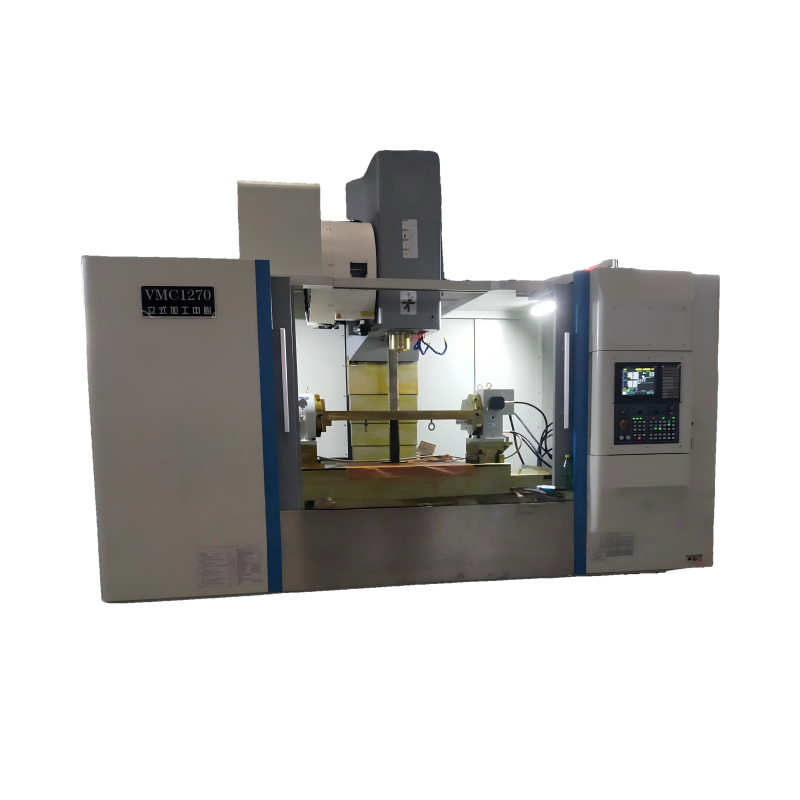
Choosing the right Vertical Machining Center (VMC) for your project, especially when it involves mold making, can be a daunting task. With so many options available on the market, each with its unique features and capabilities, it's crucial to understand the key factors that will influence your decision. This guide aims to provide you with a comprehensive understanding of what to look for in a VMC, particularly one suited for mold making, ensuring that you make an informed choice that aligns with your specific needs and budget.
A Vertical Machining Center (VMC) is a type of CNC machine designed for precision milling operations. It features a vertically oriented spindle axis, which allows for the machining of parts from multiple angles. The primary advantage of using a VMC over other types of CNC machines, such as Horizontal Machining Centers, lies in its versatility and ease of use. For mold making, where intricate details and high accuracy are paramount, a VMC is often the preferred choice due to its ability to handle complex geometries and tight tolerances.
When selecting a VMC for mold making, it’s essential to consider several key aspects, including the size of the work envelope, the rigidity of the machine, and the quality of the control system. These factors will significantly impact the precision and efficiency of your mold-making process.
The work envelope, or the maximum working area of the VMC, is a critical factor to consider. Molds can vary greatly in size, from small, intricate components to large, complex structures. Therefore, it’s important to choose a VMC with a work envelope that can accommodate the largest molds you plan to produce. Additionally, the Z-axis travel should be sufficient to handle deep cavities and tall molds without compromising on accuracy.
Rigidity is another crucial aspect, as it directly affects the stability and precision of the machining process. A rigid VMC is less likely to vibrate during operation, which is essential for maintaining tight tolerances and achieving high-quality surface finishes. Look for VMCs with heavy-duty construction, robust linear guides, and high-precision ball screws. These features ensure that the machine can handle the forces generated during cutting without deflection or loss of accuracy.
The control system is the brain of the VMC, and its capabilities can significantly impact the overall performance and usability of the machine. For mold making, a control system that supports advanced programming features, such as 3D toolpaths and high-speed machining, is highly beneficial. Modern VMCs often come equipped with advanced controls that offer intuitive user interfaces, making it easier to program and operate the machine.
Additionally, the software used to create and manage the toolpaths is equally important. CAD/CAM software that integrates seamlessly with the VMC’s control system can streamline the entire mold-making process. Features like automatic tool path optimization, collision detection, and real-time simulation can help you achieve more efficient and accurate results. When evaluating VMCs, ensure that the control system is compatible with the CAD/CAM software you plan to use, and that it offers the necessary features to support your mold-making requirements.
The spindle speed and power of a VMC are key factors that determine its cutting capability and efficiency. In mold making, high spindle speeds are often required to achieve fine surface finishes and intricate details. A VMC with a high-speed spindle, typically ranging from 10,000 to 20,000 RPM or higher, is ideal for this purpose. However, it’s also important to consider the spindle’s power, as it affects the machine’s ability to remove material efficiently, especially when working with harder materials.
For applications involving hard metals or deep cuts, a VMC with a powerful spindle, capable of delivering high torque at lower speeds, is essential. This combination of high speed and power ensures that the VMC can handle a wide range of materials and cutting conditions, providing the flexibility needed for various mold-making projects.
An efficient tool changer is a critical component of a VMC, especially in mold making where multiple tools are often required to complete a single job. A reliable and fast tool changer can significantly reduce setup times and increase productivity. Look for VMCs with automatic tool changers (ATCs) that have a high capacity and quick changeover times. This feature allows for seamless transitions between different tools, minimizing downtime and maximizing throughput.
Tool management is another important aspect to consider. Advanced VMCs often come with integrated tool management systems that track tool usage, wear, and life. These systems can help you optimize tool usage, reduce waste, and ensure that the right tools are always available for the job. Additionally, some VMCs offer features like tool breakage detection and automatic tool compensation, which further enhance the reliability and accuracy of the machining process.
Selecting the right VMC for mold making requires careful consideration of several key factors, including the work envelope, machine rigidity, control system, spindle speed and power, and tool changer and management. By evaluating these aspects, you can ensure that the VMC you choose is well-suited for your specific mold-making needs. Whether you are a small shop looking to expand your capabilities or a large manufacturer aiming to improve efficiency, the right VMC can make a significant difference in the quality and productivity of your mold-making operations.
Remember, the ultimate goal is to find a VMC that not only meets your current requirements but also has the flexibility and scalability to support future growth and innovation. By following the guidelines outlined in this article, you can make an informed decision and invest in a VMC that will serve your mold making needs for years to come.
 25/06/2026
In the domain of manufacturing, especially in the production of high-precision molds, the integration of advanced technology is not just a trend but a necessity. One such technological advancement that has revolutionized the mold making industry is the Ve
Read More25/06/2026In the realm of manufacturing, precision and speed are paramount. One of the most critical processes in this field is mold making, which demands both high accuracy and efficiency. The advent of advanced VMC (Vertical Machining Center) systems has revoluti
Read More24/06/2026In the ever-evolving world of manufacturing, the precision and efficiency of mold making have become increasingly critical. The advent of advanced machining technologies, such as Vertical Machining Centers (VMC), has revolutionized the way molds are desig
Read More24/06/2026In the ever-evolving landscape of manufacturing, the integration of advanced technology has become a cornerstone for innovation and efficiency. One such technological advancement that is revolutionizing industries is the Mold Making VMC (Vertical Machinin
Read More24/06/2026In the rapidly evolving world of manufacturing, precision and efficiency are not just desirable; they are absolute necessities. This is especially true in mold making, where the slightest deviation can lead to significant quality issues. One technology th
Read More23/06/2026In the ever-evolving landscape of manufacturing, technological advancements are reshaping the way we produce goods. One such technology that has gained significant attention is Vertical Machining Center (VMC) technology. This report delves into the future
Read More23/06/2026With the rapid advancement in manufacturing technologies, the demand for precision and efficiency has never been higher. One of the key areas where this is evident is in mold making, particularly with the use of VMC (Vertical Machining Centers). This repo
Read More23/06/2026In the intricate world of manufacturing, precision is not just a preference but a necessity. The ability to create molds with high accuracy and consistency is crucial for industries ranging from automotive to electronics. This report delves into the art o
Read MoreOur professional sales team is always ready to assist you.