In the realm of precision machining, the 2-Axis CNC Lathe stands out as a versatile and indispensable tool. This comprehensive guide aims to provide a detailed understanding of 2-Axis CNC Lathe programming, covering essential concepts, practical applications, and advanced techniques.
Understanding the Basics of 2-Axis CNC Lathes
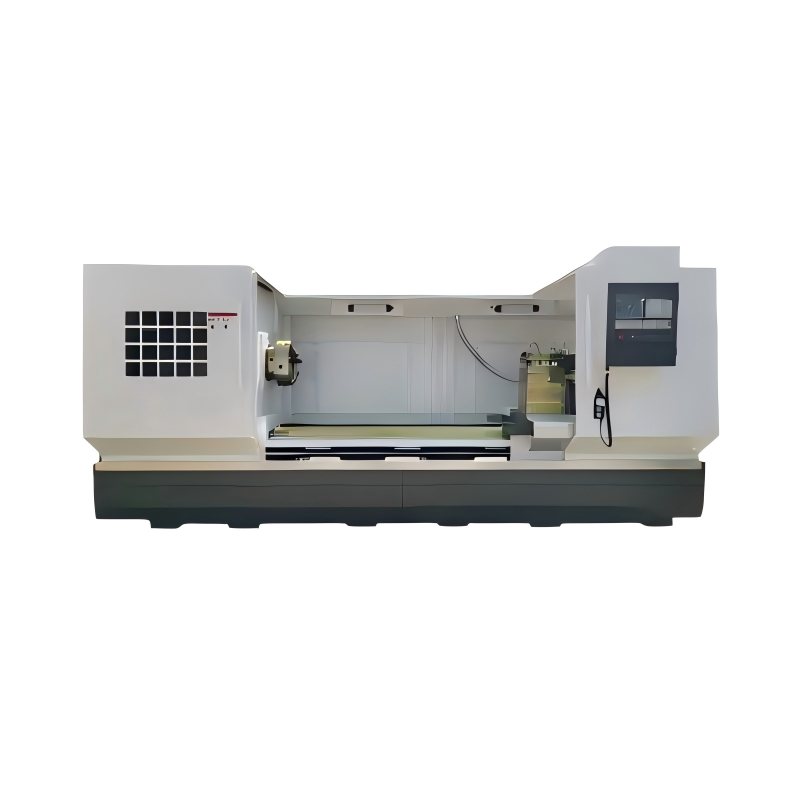
A 2-Axis CNC Lathe is a machine that operates along two axes: the X-axis (horizontal) and the Z-axis (longitudinal). The X-axis controls the movement of the cutting tool towards or away from the workpiece, while the Z-axis controls the longitudinal movement of the workpiece. This dual-axis capability allows for the creation of complex cylindrical and conical shapes with high precision.
The fundamental components of a 2-Axis CNC Lathe include the spindle, chuck, tool turret, and control system. The spindle rotates the workpiece, the chuck holds it in place, the tool turret houses the cutting tools, and the control system manages the entire operation through programmed instructions.
Programming Fundamentals for 2-Axis CNC Lathes
Programming a 2-Axis CNC Lathe involves creating a set of instructions that the machine follows to produce the desired part. These instructions are written in a language called G-code, which is a standardized numerical control (NC) programming language used by most CNC machines.
Basic G-codes for 2-Axis CNC Lathes include:
- G00: Rapid positioning
- G01: Linear interpolation (straight line motion)
- G02/G03: Circular interpolation (circular motion, clockwise and counterclockwise respectively)
- M codes: Miscellaneous functions (e.g., M03 for spindle start, M05 for spindle stop)
Understanding these G-codes and their parameters is crucial for effective programming. For example, the G01 command requires specifying the target coordinates and the feed rate, which determines the speed at which the tool moves.
Advanced Techniques in 2-Axis CNC Lathe Programming
While basic programming covers the essentials, advanced techniques can significantly enhance the capabilities of a 2-Axis CNC Lathe. One such technique is the use of subroutines, which allow for the repetition of common operations without rewriting the same code multiple times.
Another advanced technique is the use of canned cycles, which are pre-programmed sequences that perform specific tasks, such as drilling or threading. Canned cycles reduce the amount of G-code needed and simplify the programming process. For example, the G76 cycle is commonly used for threading operations and automates the process of creating threads on a workpiece.
Macro programming is another powerful feature that allows for the creation of custom commands and functions. Macros can be used to automate complex operations, perform calculations, and even generate G-code dynamically based on input parameters.
Optimizing Tool Paths for Efficiency and Precision
Efficient tool paths are critical for maximizing the productivity and accuracy of a 2-Axis CNC Lathe. Optimizing tool paths involves several considerations, including the selection of appropriate cutting tools, the sequence of operations, and the use of high-speed machining techniques.
Tool selection should be based on the material being machined, the desired surface finish, and the required tolerances. High-performance cutting tools, such as carbide inserts, can significantly improve machining efficiency and extend tool life.
The sequence of operations should be planned to minimize the number of tool changes and reduce the overall machining time. For example, performing all roughing operations before moving on to finishing operations can help maintain consistent tool wear and improve surface finish.
High-speed machining (HSM) techniques, such as using high feed rates and optimized cutting parameters, can further enhance the performance of a 2-Axis CNC Lathe. HSM not only increases productivity but also reduces tool wear and improves the quality of the finished part.
Quality Control and Post-Processing in 2-Axis CNC Lathe Operations
Ensuring the quality of the machined parts is a critical aspect of 2-Axis CNC Lathe operations. Quality control measures include in-process inspections, final inspections, and post-processing steps to achieve the desired specifications.
In-process inspections involve monitoring the machining process to detect any deviations or errors. This can be done using various sensors and measuring devices, such as touch probes and laser scanners. In-process inspections help identify and correct issues early, reducing the likelihood of producing defective parts.
Final inspections are performed after the machining process is complete to verify that the part meets the specified dimensions and tolerances. Common inspection methods include coordinate measuring machines (CMMs), optical comparators, and micrometers. Final inspections ensure that the part is within the required specifications and ready for use.
Post-processing steps, such as deburring, polishing, and heat treatment, may be necessary to achieve the desired surface finish and mechanical properties. Deburring removes sharp edges and burrs, while polishing enhances the surface finish. Heat treatment can improve the hardness, strength, and durability of the part.
By mastering the fundamentals, advanced techniques, and quality control measures, operators can fully leverage the capabilities of a 2-Axis CNC Lathe to produce high-quality, precision-machined parts. This comprehensive guide serves as a valuable resource for both beginners and experienced professionals in the field of CNC machining.
 24/06/2026



