The evolution of machining technology has witnessed significant advancements, with the 2-Axis Slant Bed CNC Lathe standing out as a pivotal innovation. This comprehensive guide delves into the intricacies of this machinery, offering insights into its design, operational capabilities, and application areas, providing both novices and seasoned professionals with a deeper understanding of how to leverage these lathes for optimal manufacturing outcomes.
Understanding the Design and Architecture
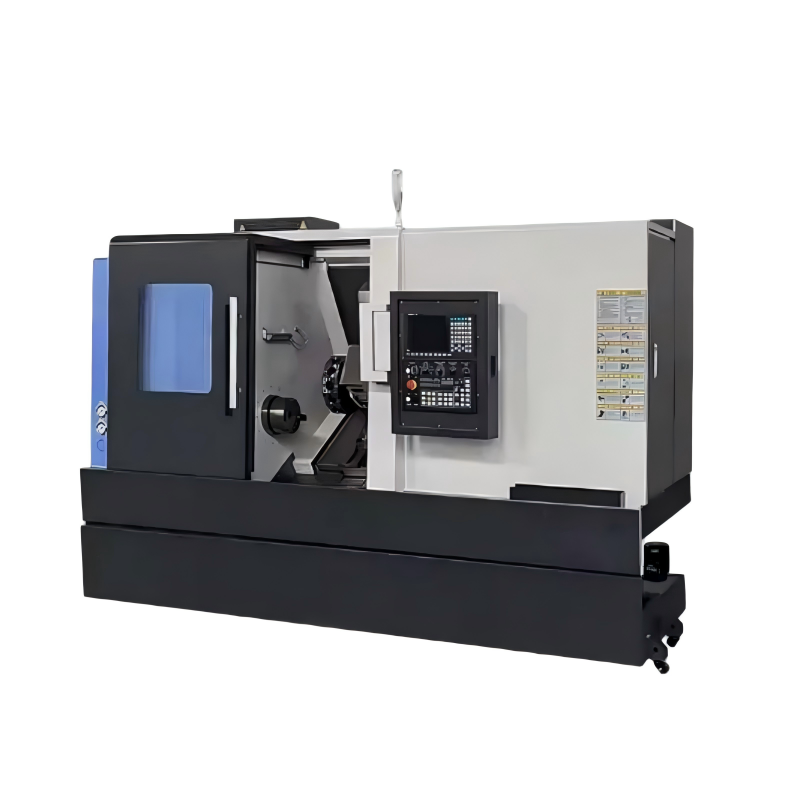
The 2-Axis Slant Bed CNC Lathe is characterized by its distinctive slanted bed structure, which offers several advantages over traditional horizontal or vertical configurations. The slant design facilitates better chip evacuation, reducing the risk of damage to the workpiece and tooling, and improving overall machine efficiency. Moreover, the angled bed provides enhanced rigidity, allowing for more precise operations at higher speeds. Understanding these architectural elements is crucial for appreciating the lathe's superior performance in various machining scenarios.
Another key aspect of the 2-Axis Slant Bed CNC Lathe is its control system. Modern lathes are equipped with advanced CNC (Computer Numerical Control) systems that enable high-precision machining. These systems can interpret complex G-code instructions, translating them into movements that produce intricate parts with tight tolerances. The integration of sophisticated software also allows for real-time monitoring and adjustment, ensuring consistent quality across production runs.
Operational Capabilities and Features
The 2-Axis Slant Bed CNC Lathe boasts an array of features that make it a versatile tool in the manufacturing industry. One of its primary functions is turning, where the workpiece is rotated while the cutting tool moves along two axes—typically X and Z—to remove material. This dual-axis movement enables the creation of cylindrical, conical, and other geometric shapes with high accuracy. Additionally, many models come with live tooling options, allowing for milling, drilling, and tapping operations, thereby expanding their functionality beyond basic turning.
In terms of speed and power, 2-Axis Slant Bed CNC Lathes are designed to handle a wide range of materials, from soft metals like aluminum to harder alloys such as stainless steel. High spindle speeds, coupled with robust motor power, ensure efficient material removal rates, making these machines suitable for both small-batch and large-scale production. The inclusion of automatic tool changers further enhances productivity by minimizing downtime between operations, enabling seamless transitions between different tasks.
Application Areas and Industry Impact
The versatility of the 2-Axis Slant Bed CNC Lathe makes it indispensable across multiple industries. In the automotive sector, these lathes are used to manufacture engine components, transmission parts, and other critical assemblies. Their ability to achieve fine surface finishes and tight dimensional tolerances ensures that the final products meet stringent quality standards. Similarly, in aerospace, the precision and reliability of these machines are leveraged to produce high-tolerance parts, contributing to the safety and performance of aircraft.
Moreover, the 2-Axis Slant Bed CNC Lathe plays a vital role in the medical device industry, where it is employed to create implants, surgical instruments, and other medical equipment. The need for biocompatible materials and exact specifications necessitates the use of advanced machining technologies, and these lathes deliver on all fronts. In the consumer goods sector, they are used to produce everything from household appliances to electronic components, demonstrating their broad applicability and adaptability.
As manufacturing trends continue to evolve, the 2-Axis Slant Bed CNC Lathe remains a cornerstone of modern machining. Its combination of precision, flexibility, and efficiency positions it as a go-to solution for manufacturers looking to stay competitive in a rapidly changing landscape. By leveraging the full potential of these machines, businesses can not only enhance their production capabilities but also drive innovation and growth in their respective fields.

 29/06/2026



